Hi everyone,
I’d like to share **3we** — an open-source platform I’ve been building that provides an AI-First Python API on top of ROS2/Nav2, targeting Embodied AI researchers who want to focus on algorithms rather than ROS2 infrastructure.
## The Problem
AI researchers (especially those working with VLMs/VLAs) often want to deploy models on real robots but face:
- Steep ROS2 learning curve (launch files, topics, services, actions)
- No clean path from simulation to hardware
- Existing platforms are either too expensive (TurtleBot 4: $1,200+) or simulation-only (Habitat, Isaac Lab)
## What 3we Does
```python
from threewe import Robot
async with Robot(backend=“gazebo”) as robot:
image = robot.get_camera_image()     # (H,W,3) uint8

scan = robot.get_lidar_scan()        # LaserScan

**await** robot.move_to(x=5.0, y=3.0)   # Nav2 under the hood
```
Change `backend=“gazebo”` to `backend=“real”` — same code runs on physical hardware. The ROS2/Nav2 stack is fully transparent to the user.
**Four backends with identical API:**
- `mock` — zero-dependency 2D kinematics (no ROS2 needed, runs anywhere)
- `gazebo` — Gazebo Harmonic with full physics
- `isaac_sim` — NVIDIA Isaac Sim for GPU-accelerated RL training
- `real` — Physical hardware via ROS2 topics
## Architecture
```
┌─────────────────────────────────────────┐
│ AI-First Python API (user layer) │ ← Researchers write code here
├─────────────────────────────────────────┤
│ 3we-core (middleware) │ ← Backend dispatch, sensor fusion
├─────────────────────────────────────────┤
│ ROS2 / micro-ROS (infrastructure) │ ← Transparent to users
│ Nav2, slam_toolbox, ESP32 drivers │
└─────────────────────────────────────────┘
```
This is NOT a replacement for ROS2 — it’s a layer on top that makes ROS2 accessible to ML researchers while preserving full ROS2 compatibility for roboticists who want low-level access.
## VLM-Controlled Navigation
The killer feature for AI researchers: GPT-4o (or any OpenAI-compatible VLM) can directly control the robot through natural language:
```python
async with Robot(backend=“gazebo”) as robot:
result = **await** robot.execute_instruction(

    "find the red bottle and stop near it"

)

print(f"Success: {result.success}")
```
Internally this runs a perception-action loop: capture image → send to VLM → parse JSON action → execute → repeat until done. Works with GPT-4o, Qwen-VL, or local LLaVA.
## Hardware ($300 BOM)
Fully open reference hardware under CERN-OHL-P v2:
| Component | Selection |
|-----------|-----------|
| Compute | Raspberry Pi 5 (8GB) |
| AI Accelerator | Hailo-8L (13 TOPS) |
| MCU | ESP32-S3 + micro-ROS |
| LiDAR | LD06 (360°, 2D) |
| IMU | BNO055 (9-axis) |
| Drive | 4× N20 motors + Mecanum wheels + DRV8833 |
| Safety | Dual-channel relay (ISO 13850 E-stop) |
KiCad 8 PCB files, DXF mechanical drawings, and assembly docs all included.
## ROS2 Integration Details
For ROS2 developers who want to know what’s under the hood:
- **Navigation**: Nav2 with DWB planner, parameters tuned for mecanum kinematics
- **SLAM**: slam_toolbox (online async) with LD06
- **MCU bridge**: micro-ROS on ESP32-S3 via USB-C serial transport
- **Sensor fusion**: robot_localization EKF (IMU + wheel odometry)
- **Launch**: Composable nodes, configurable via YAML profiles
You can always drop down to raw ROS2 topics/services if needed — the Python API doesn’t hide or lock you out.
## Benchmark Suite
7 standardized scenes with reproducible baselines:
```bash
threewe benchmark run --task pointnav --scene office_v2 --episodes 100
```
Gymnasium-compatible environments for RL:
```python
import gymnasium as gym
env = gym.make(“3we/Navigation-v1”, scene=“office_v2”, backend=“mock”)
```
## Demo
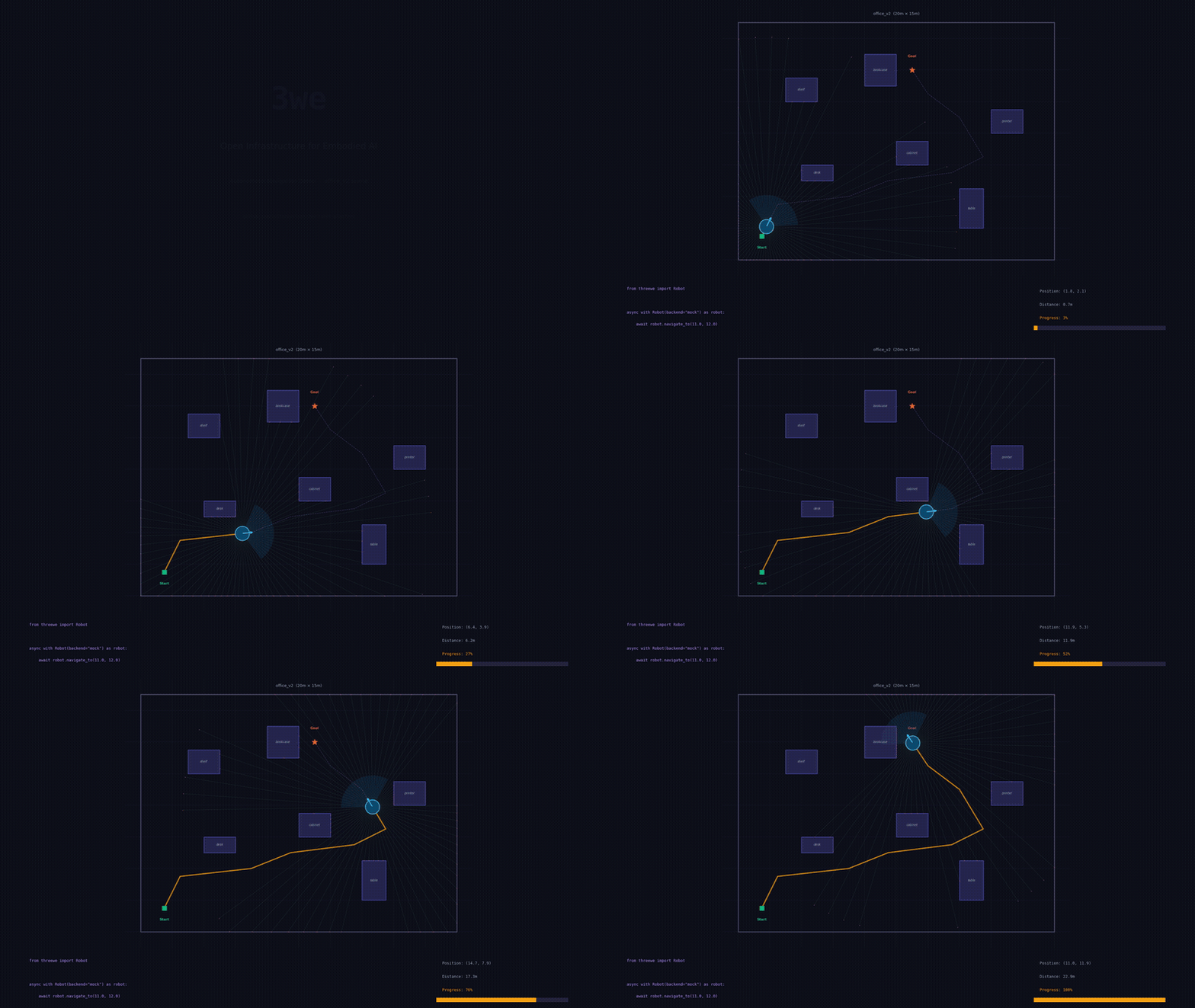

Autonomous point-to-point navigation in office_v2 scene with 360° LiDAR visualization.
## Links
- **Documentation**: https://3we.org
- **Paper**: Paper - 3we
- **PyPI**: `pip install threewe`
Feedback welcome — especially from Nav2 users on whether the API abstraction makes sense, and from AI researchers on what’s missing for their workflows.
Software: Apache 2.0 | Hardware: CERN-OHL-P v2 | Docs: CC-BY-SA 4.0