Hey everyone 
At ROSCon UK 2025, we ran a half-day workshop focused on one of the trickiest but most rewarding topics in robotics education — teaching with ROS 2.
Between complex tooling, steep learning curves, and the constant juggle between theory and hands-on work, teaching robotics can be… let’s just say character-building. 
So, we brought together educators, students, and developers to share honest experiences, compare approaches, and talk about how we can make teaching ROS 2 a bit smoother, smarter, and more inspiring.
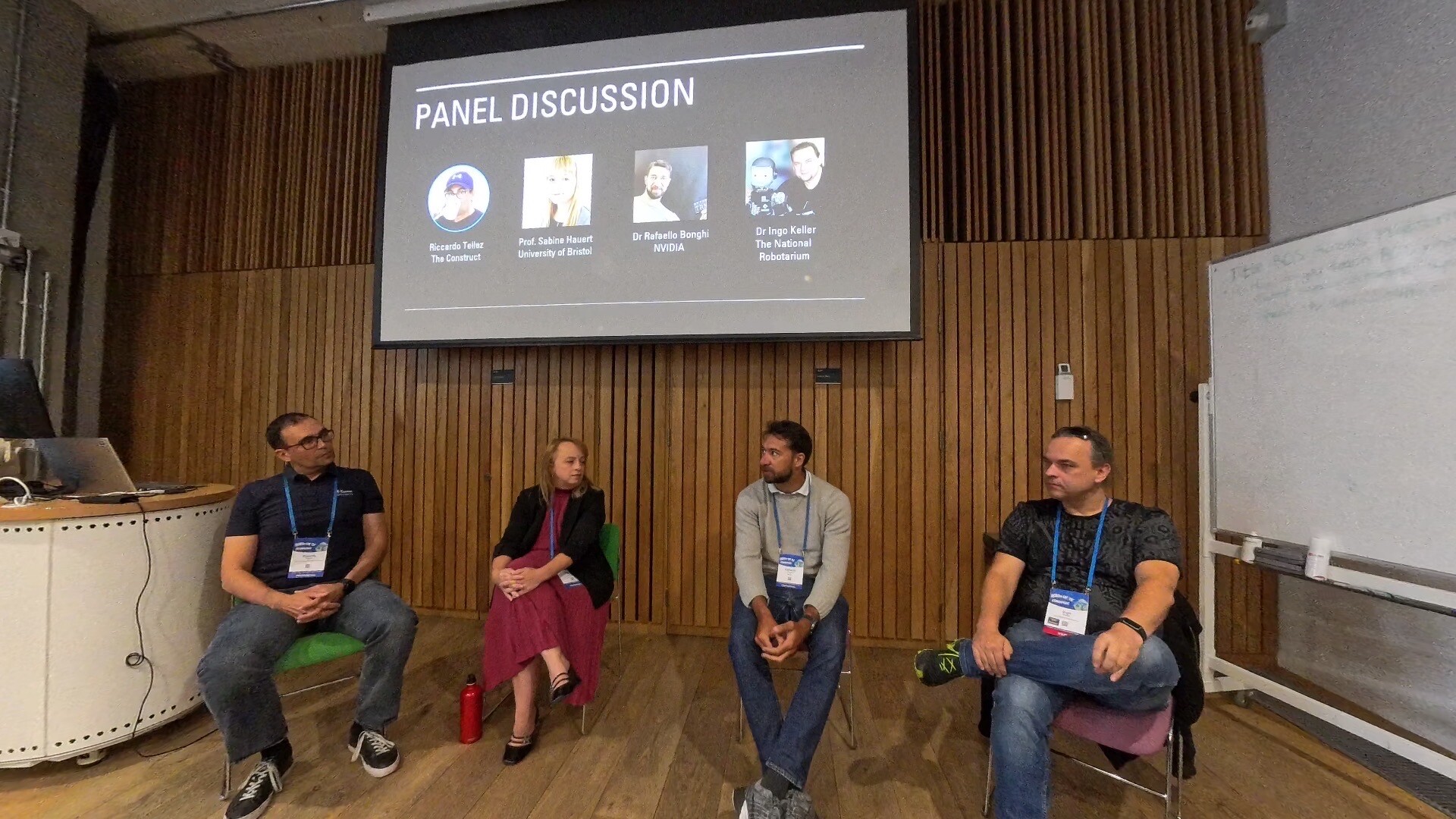
The session mixed lightning talks, demos, a panel discussion and audience whiteboarding session with contributions from university educators, open-source developers, and industry partners.
We heard from educators at UCL, Bristol, Lincoln, TU Delft, The Construct, NVIDIA, the National Robotarium, and Robotical — each sharing what’s working (and what isn’t) in their classrooms, labs, and online teaching.


What We Learned
A few key themes emerged across the day:
-
Make setup painless.
Containerized, “just-works” environments (Docker, VS Code dev-containers) can cut setup from weeks to minutes and let students start learning straight away. -
Link simulation and hardware.
Tools like Gazebo, Isaac Sim, and Zenoh bridges help students move smoothly from sim to real robots — essential for deeper understanding and scalable teaching. -
Teach from the student’s perspective.
Great reference material isn’t always great teaching material. We need resources that follow how students actually learn — concept by concept, with visible results. -
Balance empowerment and scale.
Letting students pursue their own projects drives motivation, but it needs good scaffolding and reproducible tools to work for large classes. -
Embrace AI — but teach it critically.
Robotics and AI are now inseparable. Students should know how to use AI safely, validate its outputs, and think critically about when (and when not) to trust it. -
Specialisation is OK.
The “full-stack roboticist” ideal is fading. We need pathways that acknowledge special roles — perception, control, HRI, software — while keeping collaboration at the core. -
Build community and share resources.
Many of us are solving the same problems in isolation. There’s a big appetite to create a shared network for open teaching materials, reproducible stacks, and best practices.

The Big Picture
Teaching robotics with ROS 2 isn’t easy — but the community is moving in the right direction.
If we can keep sharing containers, course materials, and hard-won lessons, we can make robotics education both more scalable and more human.
 You can read the full workshop summary (and watch all the talks + panel discussion + links!) attached, with a youtube playlist of talks here:
- ROSCON UK 2024 Write Up.pdf (1.5 MB)
- https://www.youtube.com/playlist?list=PLumWhdyXtYI0eCZwEspiCQv0oLa6_QtSb
Huge thanks to everyone who joined, presented, and shared their experiences — and to the ROS 2 education community for keeping the conversation alive - at the end of the day we need your help to make the change!
We’d love to hear your thoughts, ideas, or similar experiences below  — what’s working for you in teaching ROS 2?
Let’s also start compiling resources from which the community can point to!
With Thanks:
Workshop Organisers:
- Mickey Li*, Ziwen Lu*, Favour Adetunji**, Ziniu Wu***, Valerio Modugno*, Vijay Pawar*
* University College London, ** Herriot Watt University, *** University of Bristol
Speakers:
- Dr Vijay Pawar (UCL Bartlett School)
- Dr Rafaello Bonghi (NVIDIA)
- Prof. Sabine Hauert (University of Bristol)
- Prof Marc Hanheide (University of Lincoln)
- Alexander Enoch (Robotical)
- Martin Klomp (TU Delft)
- Riccardo Tellez (The Construct)
- Dr Ingo Keller (The National Robotarium)
Panel Members:
- Prof. Sabine Hauert
- Dr Ingo Keller
- Riccardo Tellez
- Dr Rafaello Bonghi
Demonstrations:
- Robotical’s Marty
- TU Delft MIRTE Robot